
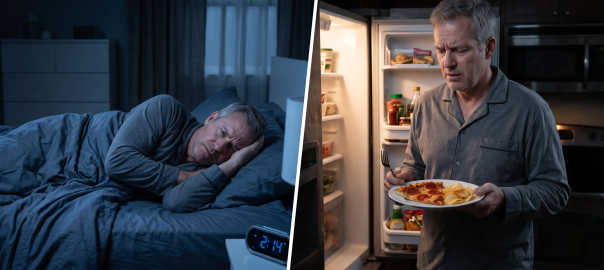
If you’re eating well but can’t shake constant hunger and cravings for junk food, your airway during sleep might be the real culprit. New research reveals how nightly breathing disruptions hijack the exact hormones that control when you feel hungry and full.
Key Takeaways
- Sleep apnea chronically disrupts ghrelin and leptin – the hormones that control hunger and fullness – making overeating a biological response, not a willpower failure.
- Elevated cortisol from nightly breathing disruptions drives cravings for high-calorie junk food and promotes stubborn abdominal fat storage.
The relationship between poor sleep and weight gain is a self-reinforcing cycle: worse apnea leads to more hunger, which leads to more weight gain, which worsens apnea. - Treating sleep apnea – through CPAP, oral appliances, or natural interventions – can help restore hormonal balance and make weight management significantly more achievable.
- Research on oropharyngeal exercises and other non-CPAP approaches is offering new paths forward for people who want drug-free options.
If hunger feels relentless no matter how much is eaten, or cravings for sugar and chips seem to strike hardest after a rough night, the problem might not be discipline. The source may be the airway – every single night.
Your Hunger May Not Be About Willpower
Constant hunger, intense cravings, and unexplained weight gain are frustrating on their own. They become even more frustrating when they persist despite eating reasonably and staying active. For many people, the missing piece is sleep – specifically, the broken, oxygen-deprived sleep that comes with obstructive sleep apnea (OSA).
Sleep apnea causes the airway to repeatedly collapse during sleep. The brain jolts the body awake to restore breathing – sometimes hundreds of times a night – without the person ever fully waking up. The result is chronic sleep deprivation that quietly rewires hunger hormones, stress responses, and metabolism. Understanding this connection is the first step toward breaking the cycle. Get Health Tips covers this hormonal disruption in depth, including natural exercise-based protocols that are gaining clinical attention as non-CPAP treatment options.
What Sleep Apnea Does to Hunger Hormones
Two hormones sit at the center of appetite regulation: ghrelin and leptin. When sleep is healthy and uninterrupted, these hormones work in balance – ghrelin rises before meals to signal hunger, and leptin rises after eating to signal fullness. Sleep apnea breaks that balance in both directions at once.
Ghrelin Spikes When Sleep Is Broken
Ghrelin is often called the hunger hormone because its job is to stimulate appetite and push the body toward eating. Sleep deprivation – the kind that happens every night with untreated OSA – causes ghrelin levels to spike significantly. A 2025 clinical trial confirmed that CPAP therapy meaningfully reduced these abnormal ghrelin surges in OSA patients, helping restore more typical hunger patterns. That finding matters because it demonstrates the ghrelin spike is not random – it is directly caused by disrupted sleep.
Leptin Drops, Fullness Signals Disappear
At the same time ghrelin is climbing, leptin is falling. Leptin tells the brain to stop eating – but with insufficient sleep, that signal weakens. A 2024 meta-analysis found that OSA is an independent cause of leptin resistance, even after accounting for body weight. The apnea itself suppresses the fullness signal, regardless of how much a person weighs. The brain stops receiving the message to stop eating, so hunger feels bottomless even after a full meal.
Cortisol: The Hidden Craving Driver
Every time breathing stops during sleep, the body interprets it as a threat and triggers a stress response. Cortisol – the primary stress hormone – surges repeatedly throughout the night. Rather than following its natural rhythm, cortisol in OSA patients can remain chronically elevated, keeping the body in a state of low-grade alert around the clock.
Chronically high cortisol intensifies cravings for high-calorie, sugary, and salty foods. This is not a character flaw – the body is seeking fast energy to cope with perceived stress. The result is waking up already craving the worst possible food choices before the day has even started.
Abdominal Fat Storage and Slowed Metabolism
Beyond cravings, sustained cortisol elevation actively changes body composition. Cortisol promotes fat storage specifically around the abdomen and breaks down calorie-burning muscle tissue over time. Chronically elevated cortisol also contributes to higher blood pressure and a measurably slower metabolic rate – making weight loss genuinely harder, not because of poor habits, but because the hormonal environment is working directly against fat loss.
Why Cravings Target Junk Food Specifically
Sleep deprivation leading to cravings for cookies, chips, and candy rather than salads is not a coincidence. Poor sleep raises blood levels of endocannabinoids – compounds that activate the brain’s reward system in ways similar to cannabis. This amplifies the enjoyment of eating and makes high-fat, high-sugar foods feel almost irresistible.
Studies have found that people with poor sleep quality tend to consume significantly higher-fat diets and potentially more than 300 extra calories per day compared to those who sleep well. That caloric surplus, repeated night after night, adds up fast – and it is driven by brain chemistry, not appetite alone.
Insulin Resistance Makes It Worse
Sleep apnea adds another metabolic obstacle: impaired insulin sensitivity. Healthy sleep helps cells respond normally to insulin, the hormone that regulates blood sugar and signals the body to burn energy rather than store it. When OSA repeatedly drops oxygen levels throughout the night, cells become less responsive to insulin – a condition known as insulin resistance.
Experimental evidence suggests OSA can directly impair mitochondrial function, which underlies this peripheral insulin resistance. The pancreas compensates by producing more insulin, blood sugar stays elevated, and the body increasingly stores excess energy as fat. This is also why OSA is strongly linked to an increased risk of developing type 2 diabetes.
The Cycle That Keeps You Stuck
Poor Sleep, Weight Gain, Worse Apnea
Each of these hormonal disruptions connects to the next, forming a cycle that is genuinely difficult to escape without addressing the root cause:
- Poor sleep from OSA raises ghrelin, drops leptin, and spikes cortisol.
- Hormonal imbalance drives overeating and intense cravings for high-calorie foods.
- Weight gain increases soft tissue around the airway, physically narrowing it during sleep.
- Worsened OSA causes even more fragmented sleep – and the cycle deepens.
This is what makes untreated sleep apnea so insidious. The condition actively creates the conditions that make it worse. Without addressing the sleep disruption itself, dieting and exercise are fighting an uphill biological battle.
Treating Sleep Apnea Restores Hormonal Balance
The encouraging finding from the research is that this cycle can be reversed. When OSA is treated effectively and breathing normalizes during sleep, the hormonal environment begins to stabilize – ghrelin drops back toward normal, leptin resistance improves, cortisol rhythms restore, and insulin sensitivity rebounds.
CPAP Therapy’s Mixed Evidence on Ghrelin Levels
Continuous Positive Airway Pressure (CPAP) is the gold-standard OSA treatment, using gentle pressurized air to keep the airway open throughout the night. The 2025 clinical trial showing reduced ghrelin spikes with CPAP use is promising, but evidence on weight loss outcomes from CPAP alone remains mixed. CPAP removes the biological obstacle of disrupted breathing and restores the hormonal conditions that make healthy habits more effective. It is not a weight-loss tool on its own, but it makes every other effort work better.
Other Effective Treatment Options
CPAP is not the only path. Several evidence-based alternatives exist depending on the severity and anatomy of the apnea:
- Custom oral appliances – Mandibular advancement devices reposition the jaw forward to keep the airway open. Effective for mild to moderate OSA without the need for a machine or mask.
- Oropharyngeal exercises – Targeted throat and tongue exercises that strengthen the muscles lining the airway, reducing its tendency to collapse during sleep. Clinical research into these protocols has shown meaningful reductions in OSA severity.
- Positional therapy – For people whose apnea worsens on their back, positional devices can reduce breathing events significantly.
- Lifestyle integration – Weight management, consistent exercise, and sleep hygiene improvements work together with primary treatments.
Better Sleep Is the Reset Your Appetite Needs
Hunger that feels uncontrollable, cravings that hit hardest at night, and weight that will not budge despite real effort can all trace back to what is happening during sleep. Sleep apnea systematically dismantles the hormonal systems that govern eating, metabolism, and body composition.
These systems are restorative. Addressing the root cause – disrupted breathing – gives the body the uninterrupted sleep it needs to rebalance ghrelin, leptin, cortisol, and insulin. For anyone dealing with unexplained weight gain or relentless hunger, the question worth asking is not what is being eaten wrong – it is how well sleep is actually happening.
Get Health Tips provides research-backed guidance on sleep, hormonal health, and weight management at gethealthtips.life.
