
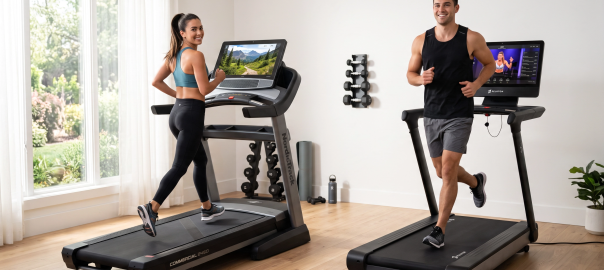
When comparing a Peloton vs. NordicTrack treadmill, most buyers focus on motor specs and belt sizes. But the number that quietly reshapes your total investment over 10 years is the monthly subscription cost — and what happens to your machine if you stop paying it.
Key Takeaways
- Peloton’s All-Access Membership costs $49.99/month as of October 2025 – and it’s practically required to get real value from the hardware.
- NordicTrack’s iFit Pro plan runs $39/month, but unlike Peloton, NordicTrack treadmills remain functional without any subscription – though the experience is significantly limited without it, especially on models with a built-in touchscreen.
- Over 10 years, the subscription gap alone can push Peloton’s total ownership cost roughly $2,200-$4,900 higher than a comparable NordicTrack setup.
- The real differentiator is not the monthly price tag – it’s how much flexibility each brand gives you when you don’t want to pay.
Most treadmill shoppers spend hours comparing motor specs, belt sizes, and incline ranges. The number that quietly matters most? The monthly subscription fee – and what happens to your machine if you stop paying it.
The Subscription Gap That Changes Everything
At first glance, $10.99 a month doesn’t sound like a dealbreaker. Zoom out over five or ten years of treadmill ownership, though, and that gap starts reshaping the entire cost comparison between Peloton and NordicTrack. Peloton’s All-Access Membership climbed to $49.99/month as of October 1, 2025. NordicTrack’s top-tier iFit Pro plan sits at $39/month. The difference is real – and it compounds.
What makes this more than a simple math problem is how each brand treats non-subscribers. That’s where the two platforms genuinely split apart, and it’s the detail that shapes long-term ownership in ways the spec sheet never will. For shoppers deep in the NordicTrack vs. Peloton research phase, Get Health Tips has a detailed breakdown of the NordicTrack T Series treadmill worth reviewing alongside this cost comparison.
Monthly Subscription Tiers Breakdown
Peloton All-Access: $49.99/Month
Peloton’s All-Access Membership is the only subscription tier designed for Peloton hardware like the Tread. There’s no lower-cost option for existing equipment owners – it’s $49.99/month or you’re running in a very stripped-down mode. The October 2025 price increase (up from $44/month) pushed the annual cost to just under $600/year for a single Peloton_vs_NordicTrack__The_Treadmill_Culture_War_Explained(1)household.
NordicTrack iFit Options ($15 vs. $39/Month)
NordicTrack’s subscription structure offers more flexibility. The iFit Train plan at $15/month is built for phones, tablets, and Bluetooth-enabled equipment that doesn’t have a built-in screen. The iFit Pro plan at $39/month is the tier that applies to most NordicTrack treadmills with a built-in touchscreen – like the Commercial 1750 – and delivers the full iFit experience with auto-adjusting incline and trainer-led destination runs.
There’s also a quieter option worth knowing: signing up directly through iFit.com can bring an individual plan down to roughly $144/year (about $12/month), which isn’t widely advertised but is a legitimate route for solo users looking to trim the cost further.
What Happens When You Stop Paying?
Peloton’s “Just Run” Mode Limitations
Without an All-Access Membership, the Peloton Tread doesn’t become a simple treadmill – it becomes a limited one. “Just Run” mode gives access to basic manual controls: speed and incline adjustments, and a moving belt. What disappears is everything else – no class library, no metrics tracking, no leaderboard, no scenic routes, and no instructor-led content of any kind. A handful of pre-recorded classes may appear, but without performance data syncing, even those feel hollow.
Most Peloton Tread owners who try going subscription-free report coming back within a month. The pull isn’t just convenience – the hardware was genuinely designed to deliver content, not to run laps quietly in a corner.
Hardware Built Around the Content
The Peloton Tread’s 23.8″ fixed HD touchscreen, the instructor integration, the real-time metrics overlay – all of it assumes a live subscription in the background. This isn’t a criticism of the product; the experience when fully subscribed is widely regarded as best-in-class for instructor-led running. But it does mean the $49.99/month isn’t optional in any meaningful sense for most buyers. It’s effectively part of the purchase price, billed monthly for the machine’s lifetime.
NordicTrack’s Manual Mode Functionality
Manual Mode: Functional but Limited
NordicTrack treadmills – including the popular Commercial 1750 – can be used entirely without an iFit subscription. Manual controls for speed, incline, and resistance all remain active. A free iFit account also unlocks a featured workout with automatic incline and speed adjustments, which is a meaningful bonus at no cost.
That said, the no-subscription experience has real limitations. The 14″ HD touchscreen on the 1750 becomes significantly less useful without iFit content populating it, and the auto-terrain features that make NordicTrack’s destination runs compelling – virtual hikes where the incline adjusts to match actual trail elevation – vanish entirely. Coach-controlled adjustments and personalized workouts also require an active plan. The machine remains fully functional as a treadmill; it just won’t perform the way it was designed to.
The practical upside: if finances shift, or a subscription just doesn’t make sense for a few months, NordicTrack owners can pause without the machine becoming a very expensive piece of furniture. That flexibility has real value over a decade of ownership.
The Real 10-Year Cost Comparison
Peloton Tread vs NordicTrack Commercial 1750: ~$2,200 More Over a Decade
Running the numbers on full subscription costs makes the gap concrete. The Peloton Tread has an MSRP of $3,295 following its October 2025 price increase, with a current sale price of approximately $2,895. Using the sale price and adding ten years of All-Access at $49.99/month, the total reaches roughly $8,894.
The NordicTrack Commercial 1750 lists at approximately $1,999 (prices vary by retailer). With ten years of iFit Pro at $39/month, the total lands around $6,679 – a difference of about $2,215. Go the discounted iFit.com individual route at ~$12/month, and that NordicTrack total drops closer to $3,440, widening the gap considerably.
Peloton Tread+ vs NordicTrack Commercial 1750: The Gap Widens to ~$4,900
Peloton’s higher-end Tread+ carries an MSRP of $6,695, with a current sale price of approximately $5,595. Factoring in a decade of All-Access at $49.99/month, total ownership reaches roughly $11,594. Measured against the 1750 at full iFit Pro pricing, that’s a gap approaching $4,915 – and potentially much more if NordicTrack’s lower-cost subscription path is used consistently.
These aren’t edge-case scenarios. They’re the realistic cost of keeping either machine running the way it was designed to run, for the lifespan a quality treadmill should have.
Subscription Flexibility Is the True Differentiator
Strip away the instructor quality debate and the screen-size comparisons, and what remains is a fundamental difference in ownership philosophy. Peloton built a treadmill that needs its subscription to justify itself – and delivers a genuinely exceptional experience when that subscription is active. NordicTrack built hardware that can flex: run it fully loaded with iFit Pro, dial it back to the budget iFit.com plan, or skip the subscription entirely during lean months without losing the machine’s core utility.
Neither approach is wrong. For buyers thinking about 5, 7, or 10 years of ownership – not just the excitement of month one – the subscription model each brand demands is at least as important as the treadmill’s motor size or its maximum incline. The monthly cost isn’t a footnote. Over time, it becomes the headline.
For more resources on home fitness equipment and making smarter long-term buying decisions, Get Health Tips covers fitness gear comparisons, ownership costs, and practical buying guides to help home gym shoppers cut through the noise.
