
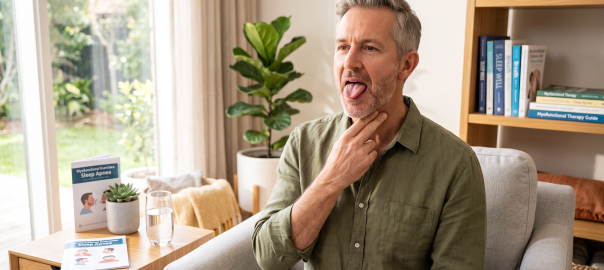
Most people with sleep apnea have never heard about oropharyngeal exercises, yet research shows they can cut apnea severity in half for many patients. The catch? You need to commit to 30 minutes daily, and not everyone will see results.
Key Takeaways
- Sleep apnea exercises – also called myofunctional therapy or oropharyngeal exercises – can reduce the Apnoea-Hypopnoea Index (AHI) by roughly 50% in adults, according to multiple systematic reviews including the Camacho et al. 2015 meta-analysis. The Cochrane review by Rueda et al. confirms a large reduction in OSA severity, though it does not quantify this as exactly 50%.
- These exercises build functional muscle tone in the tongue, soft palate, and throat – the tissues most responsible for airway collapse during sleep.
- Results are strongest for people with mild to moderate obstructive sleep apnea (OSA); for severe OSA, exercises are best used alongside established treatments like CPAP.
- Consistency matters: studies showing major AHI reductions used at least 30 minutes of daily practice over several months – sporadic effort produces much smaller gains.
- Anyone seeking non-CPAP options for sleep apnea can find a detailed breakdown of alternative therapies and evidence-based strategies at Get Health Tips.
Sleep apnea exercises have quietly built one of the most compelling evidence records in sleep medicine – yet most people with obstructive sleep apnea have never been told about them. That gap between what the research shows and what reaches patients is worth closing.
Yes – the Evidence Is Stronger Than You Think
When most people hear “sleep apnea exercises,” they picture something vague and unscientific – maybe a few tongue wiggles before bed. The reality is very different. Oropharyngeal exercises have been studied in randomized controlled trials, systematic reviews, and a Cochrane Collaboration meta-analysis, which represents the highest tier of evidence synthesis in medicine.
The headline finding: a 2015 systematic review and meta-analysis published in the journal Sleep (Camacho et al.) pooled data across multiple studies and found that myofunctional therapy reduced AHI by approximately 50% in adults. A 50% AHI reduction can shift someone from moderate OSA to mild – or from mild OSA to below the diagnostic threshold entirely. That is a clinically meaningful change. For context on non-CPAP paths forward, Get Health Tips covers the full range of alternative and adjunct therapies with the same evidence-first approach.
What Oropharyngeal Exercises Actually Do
The Muscle Tone Problem
The upper airway is held open by a coordinated network of muscles: the genioglossus (which anchors the tongue forward), the soft palate muscles, the uvula, and the lateral pharyngeal walls. These muscles work continuously during wakefulness to keep the airway clear. During sleep – especially deeper sleep stages – that muscle activity drops sharply.
In people with OSA, the baseline resting tone of these muscles is already low. When sleep causes that additional dip, the airway does not just narrow – it collapses. Myofunctional therapy targets this directly by raising baseline muscle tone through structured, repeated exercise. The goal is not bulk; it is functional stiffness and neuromuscular coordination – enough resistance to hold the airway open even as the nervous system winds down for sleep.
Why the Airway Collapses at Night
A 2026 ultrasound study (Rodriguez-Alcala et al., Sleep and Breathing) visualized what exercises do to the tongue. After three months of daily oropharyngeal drills, tongue volume in the moderate-OSA exercise group dropped by 8 cm3 anSleep-Apnea-Do-Throat-Exercises-Work
d tongue thickness fell roughly 4 mm – while tongue strength increased. Less bulk, more firmness. The result is a leaner, stronger tongue base that sits further from the posterior airway wall and resists backward collapse during sleep.
What the Research Shows
AHI Reductions Across Studies
The Camacho 2015 meta-analysis established the approximately 50% AHI reduction benchmark for adults. Subsequent research has consistently reinforced the direction of that finding. A 2025 network meta-analysis by Xu et al. reported a mean AHI reduction of approximately 8-9 events per hour compared to controls, though this did not reach statistical significance for adults as a group; the same analysis did find consistent improvements in Epworth Sleepiness Scale and Pittsburgh Sleep Quality Index scores, indicating meaningful gains in daytime function and sleep quality.
What the Cochrane Review Actually Concluded
The Cochrane Collaboration review by Rueda et al. (2020) is the credibility anchor here. Cochrane reviews demand pre-registered methodology, independent verification, and formal risk-of-bias assessment. Their conclusion: oropharyngeal exercises produce a large reduction in OSA severity and daytime sleepiness in adults compared to control conditions, though the review found little to no effect on snoring frequency specifically. A 2025 overview published in the Journal of Sleep Research (Pisoni et al.) confirmed these findings hold across multiple independent research groups. This is mainstream peer-Sleep_Apnea_Exercises__Do_They_Actually_Work__The_Sciencereviewed evidence.
Snoring Findings: Real but Modest
For primary snoring, a 2018 systematic review by Camacho et al. found a 31% reduction in the proportion of the night spent snoring, and a 36-51% reduction in subjective snoring intensity. That said, the Cochrane review noted little to no effect on snoring frequency, and at least one network meta-analysis found AHI reduction did not always reach statistical significance – though improvements in subjective outcomes like daytime sleepiness and sleep quality were consistent. The snoring evidence is real, but results vary across individuals.
Which Exercises Have Real Evidence
Tongue Exercises
Tongue-targeted exercises have the strongest and most replicated evidence base. Two drills appear consistently across meta-analyses:
- Tongue press: Press the tongue firmly against the roof of the mouth and hold. This tones the genioglossus – the primary muscle preventing the tongue from collapsing backward into the airway.
- Tongue slide: Slide the tip of the tongue backwards along the palate as far as possible. This activates both the posterior tongue and the soft palate simultaneously.
A related technique – swallowing retraining with correct tongue posture – recruits the full pharyngeal musculature and retrains resting tongue position over time.
Soft Palate and Throat Drills
The soft palate and uvula are the structures most associated with the vibration that Sleep_Apnea_Exercises__Do_They_Actually_Work__The_Scienceproduces snoring. Exercises that target them include:
- Sustained vowel sounds: Elevating the soft palate repeatedly through held vowel sounds builds endurance in the palatal muscles.
- Gargling with sustained tone: Targets the lateral pharyngeal walls – a key collapse zone in OSA – through pharyngeal resistance training.
- Resisted swallowing: Engages throat musculature in a way that parallels resistance training for limb strength.
Nasal Breathing as a Complementary Technique
Deliberate nasal-only breathing – practiced during rest and exercise – restores nasal airflow and reduces the pharyngeal collapse associated with mouth breathing. Work by Carrasco-Llatas et al. (2021) supports nasal breathing training as a useful complement to tonguSleep_Apnea_Exercises__Do_They_Actually_Work__The_Sciencee and palate drills.
Who Benefits Most
Best Candidates: Mild to Moderate OSA
Myofunctional therapy produces its strongest results in people with mild to moderate OSA (AHI roughly 5-30 events per hour) and in people with primary snoring but no clinically significant apnea. For these groups, exercises can function as a meaningful first-line or standalone option. Some patients with moderate OSA have reduced their dependence on CPAP after consistent therapy – though this should always be confirmed with follow-up sleep testing and discussed with a clinician.
When Exercises Alone Won’t Be Enough
Exercises address the muscular component of airway obstruction. They do not move structural anatomy. People with enlarged tonsils, significantly blocked nasal passages, or a narrow jaw architecture are unlikely to see full resolution from exercises alone – those structural issues need to be addressed separately. Anyone with severe OSA (AHI above 30) should treat exercises as a complement to CPAP or other therapies, not a replacement. People who developed snoring gradually through middle age tend to respond better than lifelong snorers, where a structural cause is more probable.
How Long and How Often
The trials showing the largest AHI reductions used daily practice of at least 30 minutes over 8-12 weeks. The 2026 Rodriguez-Alcala study used approximately 20 minutes per day, most days of the week, for three months. The pattern across studies is consistent – sporadic or brief practice produces far smaller effects. Treat it like physical therapy: frequency and duration both matter.
Honest Limitations Worth Knowing
No treatment deserves an uncritical endorsement, and myofunctional therapy is no exception.
- Short study durations: Most trials run weeks to months – long-term durability beyond 6-12 months is not well established.
- Protocol variability: Exercise combinations, durations, and sequences vary considerably across studies; there is no single definitive best protocol yet.
- Not a universal fix: Evidence in children is sparse, and pediatric OSA is usually structural. For moderate-to-severe OSA in adults, exercises are an adjunct, not a cure.
- Inconsistent AHI findings: At least one network meta-analysis found AHI reduction did not reach statistical significance, even when subjective outcomes improved.
None of these caveats undermine the core finding – but they are worth knowing before committing to an exercise program as a sole strategy.
Non-CPAP Relief Is Real – If You Put In the Work
For people with mild to moderate OSA or primary snoring who want a non-device, non-drug option, the evidence for oropharyngeal exercises is genuinely solid. Multiple independent research groups, a Cochrane review, and a 2025 overview of systematic reviews all point in the same direction: consistent daily practice of targeted tongue, palate, and throat exercises produces measurable, clinically relevant reductions in AHI and improvements in sleep quality. There are no side effects, no equipment costs, and no prescriptions involved. The only real requirement is daily commitment – and doing the work long enough for the muscles to adapt.
For a broader look at evidence-based non-CPAP strategies and practical sleep health guidance, visit Get Health Tips – a resource dedicated to helping readers make informed decisions about their health.
