
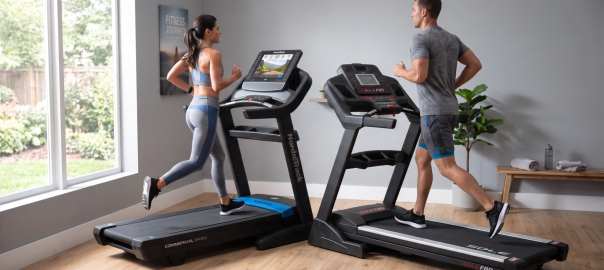
Most home treadmills max out at 300 lbs, quietly excluding a significant portion of potential users. Here’s the critical difference: Bowflex offers 400-lb capacity at mid-range prices, while NordicTrack reserves its highest-capacity models for premium buyers. But weight limits tell only part of the story.
Key Takeaways
- Most home treadmills cap out at 300 lbs – a limit that quietly excludes a large segment of users before they ever step on the belt.
- Bowflex leads on inclusivity, with two of its treadmill models confirmed at 400 lbs; NordicTrack’s 400-lb models are limited to its higher-end Commercial series.
- Fitness professionals widely recommend choosing a treadmill with a weight capacity well above your body weight when running – the exact buffer varies, but a common guideline is at least 20-30% above your current weight, which changes which models are actually viable for many buyers.
- Deck length matters just as much as weight capacity, especially for taller users or those with longer strides.
- Get Health Tips breaks down both brands side by side to help you find a machine that actually fits – check out the full NordicTrack T Series treadmill listing as a starting point for the comparison.
Weight Capacity Comparison
Walk into a fitness equipment showroom and the treadmills all look about the same – sleek belts, bright screens, promising specs. Hidden in the fine print, though, is a number that quietly tells a large portion of shoppers to look elsewhere: the maximum user weight capacity.
The average home treadmill supports between 250 and 300 lbs. For many users, that’s plenty. For a meaningful portion of the population – including people who are heavier, taller, or simply built bigger – that cap turns a treadmill from a fitness tool into a liability. Running on a machine near or above its rated limit accelerates wear, degrades performance, and creates real safety risks over time.
This is exactly where brand choice starts to matter. NordicTrack and Bowflex both serve the home fitness market, but they take different approaches to user weight capacity across their treadmill lineups – and those differences directly affect who can use these machines safely and comfortably.
Bowflex Weight Limits
Bowflex offers a focused treadmill catalog, and several of its models punch well above the industry standard on weight capacity.
Treadmill 22: Confirmed 400-lb Capacity
The Bowflex Treadmill 22 is the clearest win for inclusivity in this comparison. It carries a confirmed 400-lb maximum user weight capacity, a 60-inch cushioned running deck, incline and decline capability ranging from -5% to 20%, and a 22-inch HD touchscreen connected to the JRNY platform. The frame is backed by a 15-year warranty, with mechanical parts covered separately under a shorter warranty term. For users who have historically felt underserved by standard-capacity machines, this model makes a direct statement.
Treadmill 10: 400 lbs, With a Retailer Caveat
The Bowflex Treadmill 10 is also listed at a 400-lb capacity, though some retail listings vary slightly in their published specs. Cross-referencing before purchasing is always a smart move. This model shares the same 60-inch running deck as the Treadmill 22, keeping it firmly in the high-capacity tier.
T6 and T9: Where Bowflex Falls Short
Not every Bowflex model clears the bar. The Bowflex T6 tops out at approximately 325 lbs – above the industry average but still below the 400-lb threshold – and the Bowflex T9 sits at 350 lbs. These are competitive machines in many respects, but users at the higher end of the weight range will want to look at the Treadmill 10 or 22 instead.
NordicTrack Weight Limits
NordicTrack runs a larger treadmill lineup, which creates more variety but also more inconsistency on weight capacity. The brand is not uniformly high-capacity, and that distinction matters depending on which model ends up in the cart.
T Series and Entry Models: Still at 300 lbs
Several of NordicTrack’s more accessible treadmills – including the T 6.5, T Series 5, T Series 7, and the Commercial 1250 (2024) – carry a 300-lb weight limit. That sits at the lower boundary of what’s considered acceptable for general home use. For walkers or lighter users, this is fine. For anyone running near that limit, the margin is uncomfortably thin.
Commercial 1750 and 2450: The High-Capacity Tier
NordicTrack’s higher-end lineup tells a different story. The NordicTrack Commercial 1750 (2024 model) has been updated to a 400-lb capacity – a meaningful upgrade over older versions of the same machine. The NordicTrack Commercial 2450 is also reported at 400 lbs across multiple sources, though capacity figures for this model have varied in some retailer listings, so confirming specs directly with NordicTrack before purchasing is advisable. Both machines include incline and decline training, iFIT compatibility, and a foldable frame with EasyLift Assist. The jump in quality is real, but so is the jump in price. NordicTrack’s 400-lb options live in the upper tier of the lineup, not spread across the range the way Bowflex manages it.
Deck Size & Belt Inclusivity
Weight capacity often gets the headline, but running deck length is just as relevant for heavier users – and for anyone who is tall or has a longer natural stride.
Bowflex’s Consistent 60-Inch Standard
The high-capacity Bowflex treadmill models come with a 60-inch running deck. That consistency is a genuine advantage. A 60-inch deck is generally considered the minimum comfortable length for users who are 6 feet tall or taller, and it accommodates a natural running gait without forced adjustment.
NordicTrack’s 55-65 Inch Range
NordicTrack’s running deck lengths span from 55 to 65 inches depending on the model. Entry-level models like the T Series start at 55 inches – workable for walking, tighter for running. The Commercial 1750 and 2450 offer longer surfaces that pair well with their higher capacity ratings. Deck length varies meaningfully across the lineup, so confirming the specific model’s dimensions before buying is worth the extra step.
Motor Power & Frame Construction for Heavy Use
The spec sheet number and the number that’s actually safe to use are not the same thing. Rated capacity is a ceiling, not a target.
The Runner’s Buffer Rule
For anyone who plans to run on their treadmill, fitness professionals recommend choosing a machine with a weight capacity meaningfully above your current body weight. Running generates significantly more impact force than walking, which puts greater stress on the motor, belt, and frame than static weight alone would suggest. A common guideline is to look for a machine rated at least 20-30% above your body weight – a rule that immediately rules out several lower-capacity models for a wide range of buyers. The specific buffer that makes sense will depend on how intensively the machine will be used and how frequently.
Why Exceeding the Limit Costs You
Using a treadmill above its rated capacity creates a cascade of problems beyond just voiding the warranty. The belt wears unevenly and faster. The motor strains under load, reducing its lifespan. The deck can develop cracks or deformation under repeated high-impact use. Beyond the mechanical toll, there’s a safety dimension: a machine operating outside its design parameters is unpredictable. Treadmills with sturdier frames, thicker decks, and reinforced cushioning systems are built to handle higher impact loads – and that engineering is what the weight rating reflects. Choosing a machine that matches or exceeds real-world use conditions is simply how the equipment is meant to work.
Bowflex Edges Ahead on Inclusivity, NordicTrack on Variety
When the goal is finding a treadmill that works for users across a wider range of body types, the two brands end up in different positions.
Bowflex makes it straightforward. Multiple models hit 400 lbs, the high-capacity options don’t require buyers to shop at the very top of the price range, and the 60-inch deck is standard on those machines. For heavier users, that predictability is valuable.
NordicTrack offers more total options, more technology, more incline variety, and a larger ecosystem through iFIT. The 400-lb capacity, though, is concentrated in the Commercial 1750 and 2450 – both premium-priced machines. Entry-level and mid-range NordicTrack models generally sit at 300 lbs, which means the inclusivity benefit comes with a higher buy-in. Though the Nordic Track X24 is worth looking at for a higher weight limit.
Neither brand is a poor choice, but they serve different priorities. Buyers who want maximum capacity without necessarily paying for top-tier specs will find Bowflex more accommodating. Buyers who want the most feature-rich experience and are willing to spend for a 400-lb Commercial model will find NordicTrack hard to beat on overall performance.
The right call depends on weight, stride length, budget, and how seriously a machine will be used – and matching those factors to the correct model is where most buyers go wrong.
For more fitness equipment comparisons, tips, and buying guides, visit Get Health Tips – a resource dedicated to helping people make smarter, more informed home fitness decisions.
