
Every person newly diagnosed with obstructive sleep apnea (OSA) hears the same two pieces of advice, usually in the same appointment, often in the same breath. The first is to use a CPAP machine — a small device that holds the airway open with a gentle stream of pressurized air while you sleep. The second is to lose weight. Both are backed by decades of clinical research, and both are sensible. What is almost never explained is which one matters more over the long run — and whether acting on one means abandoning the other.
It is a question worth answering carefully, because the stakes are real. Untreated sleep apnea is not just loud snoring. It is a condition in which the soft tissues of the throat collapse repeatedly during sleep, cutting off airflow for seconds at a time, dozens or even hundreds of times a night. Every collapse triggers a drop in blood oxygen and a jolt of stress hormones as the brain forces itself partially awake to reopen the airway. Over months and years, that nightly assault drives up blood pressure, destabilizes blood sugar, taxes the cardiovascular system, and leaves sufferers chronically exhausted, irritable, and at higher risk of accidents. [Research estimates that 60–70% of people with OSA are overweight or obese](https://cpapclarity.com/learn/sleep-apnea-weight-loss), which is why weight loss is so often prescribed alongside CPAP — but the relationship runs both ways, and that is exactly where the confusion begins. Sleep apnea itself makes weight gain easier and weight loss harder, which means the two treatments are tangled up in the same cycle they are meant to fix.
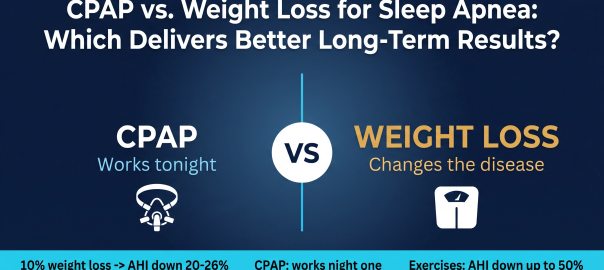
This article compares CPAP and weight loss head-to-head, digs into what the clinical evidence really says about long-term outcomes, and — because neither option suits everyone — explores a third path that is gaining serious research support: targeted tongue and throat exercises that strengthen the airway muscles themselves. If you are weighing your options, here is the honest short version: CPAP works tonight, weight loss works over years, and the people with the best long-term results are rarely the ones who picked a side. The evidence below explains why.
Key Takeaways
- CPAP is the fastest, most reliable treatment available: for most people it brings the apnea-hypopnea index (AHI) down to near-normal levels from the very first night, regardless of what is causing the apnea.
- Weight loss treats the root cause in weight-related OSA, and the research shows a clear dose–response: a 10% reduction in body weight lowers AHI by roughly 20–26%, while losses of 15–20% can cut AHI by half or more.
- The timescale decides the “winner”: CPAP delivers the results in the short term, while sustained weight loss delivers the deeper, more durable long-term improvement — but only if the weight stays off.
- Weight loss rarely cures sleep apnea. Even in major weight-loss trials, most participants still had diagnosable OSA afterward; the disease improved, but it did not disappear.
- Weight regain reliably brings the apnea back, so the long game is about sustainable change, not rapid change.
- There is a third option worth knowing about: myofunctional therapy — tongue and throat exercises — has been shown in clinical studies to reduce AHI by up to 50% in adults with mild-to-moderate OSA, with no device and no medication. [You will find the complete exercise guide here](https://gethealthtips.life/sleep-apnea-exercises-no-cpap-throat-muscle-strengthening-guide/).
- Never stop CPAP on your own. Whether you are losing weight, doing exercises, or both, the only safe way to change your treatment is with a repeat sleep study and your sleep physician’s guidance.
What CPAP Actually Delivers
CPAP — continuous positive airway pressure — works through a mechanism that is almost absurdly simple. A small machine sits beside the bed and pushes a gentle, constant column of pressurized air through a mask and into the airway. That column of air acts like an inflatable splint: it physically holds the throat open while you sleep, preventing the collapse that causes apnea. It trains no muscle, reshapes no anatomy, and changes no hormone. It simply prevents the airway from closing, night after night.
That simplicity is its greatest strength. For the large majority of people with moderate-to-severe OSA, CPAP reduces AHI to near-normal levels from the very first night it is used. There is no waiting period, no gradual build-up, no dependence on how much weight you happened to lose this month. The oxygen desaturations stop. The stress-hormone surges stop. Sleep becomes continuous and restorative, and most users notice the difference in daytime energy and alertness within days or weeks.
But CPAP has a catch, and it is a significant one: it only works while it is being used. Adherence is famously poor — a large share of patients abandon the device within the first year, citing mask discomfort, pressure-related anxiety, claustrophobia, or simply the burden of a nightly ritual. And because CPAP changes nothing about the underlying condition, stopping the machine means the apnea returns, often within a night or two. It is a nightly shield, not a cure.
There is also a subtler limitation that matters enormously for the long-term comparison at the heart of this article: CPAP manages the symptom without changing the trajectory of the disease. If your apnea is driven by excess weight, the pressurized air keeps you safe each night, but the weight — and the mechanical load it places on your neck, tongue, and throat — remains exactly where it was. CPAP buys you time and protects your health while you work on the cause. It does not, by itself, change the cause.
What Weight Loss Actually Delivers
The case for weight loss rests on the mechanics of the airway, and it is worth understanding those mechanics because they explain everything else in this article. Fat does not only accumulate around the belly and hips; it also accumulates around the structures of the upper airway, and three tissue regions matter most. Neck circumference: adipose tissue around the neck adds mass that the airway muscles literally have to hold up during sleep, and neck size predicts OSA severity even better than BMI does. Tongue fat: the tongue itself stores fat, and MRI research shows that as body weight rises, tongue volume rises with it — tongue fat is a strong, independent predictor of apnea severity. And pharyngeal wall thickening: the walls of the airway thicken as fat infiltrates them, narrowing the passage even when the airway is otherwise open. Weight loss reverses all three, though not at the same speed: neck fat tends to mobilize faster than tongue fat, which is why some people notice less snoring or fewer mask leaks before their AHI numbers budge.
The clinical evidence behind weight loss is genuinely strong, and the headline studies are worth citing. In the Wisconsin Sleep Cohort, one of the longest-running studies of sleep and health in the world, researchers found that a 10% increase in body weight was associated with a 32% increase in AHI — while a 10% weight loss was associated with roughly a 26% reduction. Note the asymmetry: gaining weight hurts more than losing it helps, a pattern that shows up in nearly every cohort study.
In the Sleep AHEAD trial, a randomized controlled study that followed overweight and obese adults with type 2 diabetes and OSA through an intensive lifestyle intervention, participants who lost about 10% of their body weight saw their AHI drop roughly 22% more than the comparison group; in the first year, close to 14% of the intervention group achieved complete remission of their sleep apnea. The caveat from that trial — one that every patient should hear — is that even with meaningful weight loss, most participants still had clinically diagnosable OSA afterward. The disease moved from severe to moderate, or moderate to mild, but it rarely resolved entirely.
A 2024 systematic review and meta-analysis in Sleep Medicine, pooling 27 studies of surgical, lifestyle, and drug-based weight-loss interventions, confirmed the dose-response pattern: a 10% reduction in BMI was associated with roughly a 36% reduction in AHI, and a 20% reduction in BMI with roughly a 57% reduction, with the benefit tapering at larger losses. Bariatric surgery produces the most dramatic results of all — a widely cited 2009 meta-analysis found mean AHI fell from about 55 to 16 events per hour after surgery — but even the authors of that study warned that the average patient’s remaining AHI was still consistent with moderately severe OSA, and that surgical weight loss alone should not be expected to cure the condition.
The newest chapter is pharmacological. In late 2024, the FDA approved tirzepatide (Zepbound) as the first medication ever indicated for obstructive sleep apnea, based on the SURMOUNT-OSA trials, in which participants lost roughly 18–20% of their body weight and saw their AHI decrease by about 55–63% at the highest dose, with 43–51.5% reaching remission or mild, non-symptomatic OSA compared with about 14% on placebo. GLP-1 medications are not a replacement for CPAP — they are a complementary tool that addresses one root cause — but they demonstrate that pharmacological weight loss reproduces the improvements seen in the lifestyle studies.
So weight loss works, and it works well at meaningful magnitudes. But it comes with three caveats that matter for the long-term question. It is slow: even an aggressive program takes six to eighteen months to produce its full effect, and during that time untreated apnea keeps doing damage. It is fragile: studies consistently show that when weight returns, the apnea returns with it — the relationship is reversible in both directions. And it is not universal: roughly 20% of OSA patients have a BMI below 30, with airway problems driven by anatomy rather than fat distribution, and weight loss does nothing for central sleep apnea, where the problem is the brain failing to send the breathing signal rather than the airway collapsing.
The Head-to-Head: Which Delivers Better Long-Term Results?
Now the question the title asks. The honest answer is that it depends on the timescale, and pretending otherwise does patients a disservice.
In the short term, there is no contest: CPAP wins, decisively. It works tonight. It works regardless of your weight, your anatomy, or the cause of your apnea. While weight loss is still months away from meaningfully changing your AHI, CPAP is protecting your heart, your blood pressure, and your daytime safety. As the team at [Haven CPAP puts it bluntly in their analysis of the research](https://www.havencpap.com/blog/sleep-apnea-weight-loss): “Weight loss takes time. Apnea damage is happening now.” Even an aggressive weight-loss program is six to eighteen months from its outcome, and untreated OSA continues to elevate cardiovascular risk, blood pressure, and glucose dysregulation the entire time.
In the long term, the picture flips — but with an important condition attached. Because CPAP does not change the disease, its long-term results look essentially like its short-term results: a well-managed condition that returns the moment the machine stops. Weight loss, by contrast, is disease-modifying. It reduces severity, often lowers the CPAP pressure needed, and in some cases brings people to a point where their doctor may consider reducing therapy or a supervised trial off CPAP entirely. Sustained weight loss is the only one of the two that can actually change your diagnosis over the years.
The condition is the word “sustained.” Weight regain reverses the gains, and the statistics on long-term weight maintenance are sobering. Moreover — and this is the detail most people never hear — weight loss and CPAP are not competitors; they are teammates, because untreated apnea actively sabotages weight loss. Untreated OSA suppresses leptin, the hormone that signals fullness, and elevates ghrelin, the hunger hormone; sleep-deprived individuals consume an estimated 300–500 extra calories per day. It promotes insulin resistance and fat storage, keeps cortisol elevated, and leaves you too exhausted to exercise. Multiple studies show that CPAP-treated patients lose weight on lifestyle interventions more reliably than untreated patients following the same protocol.
That compounding relationship is the real answer to the title question. The people with the best long-term results are not the ones who chose CPAP over weight loss or weight loss over CPAP. They are the ones who used CPAP as the bridge — protecting their sleep, their hormones, and their energy every night — while building the slow, sustainable weight change that actually alters the course of the disease. CPAP makes weight loss easier; weight loss reduces the apnea; the reduced apnea enables further weight loss. That is the loop to optimize, not a binary to choose from.
The Third Option: Throat Muscle Training
Because neither option suits everyone — CPAP is burdensome for some, and weight loss is slow and genuinely hard — a third approach has quietly moved from the fringe into the evidence base: myofunctional therapy, or targeted tongue and throat exercises. The logic is simple and elegant. The muscles of the tongue, soft palate, and pharynx are what hold the airway open during sleep, and when they lose tone, the airway collapses. Like any other muscles, they can be trained.
The research is more substantial than most people expect. A systematic review and meta-analysis found that myofunctional therapy reduced AHI by approximately 50% in adults and 62% in children, with separate studies confirming reductions in the 34–50% range. One clinical study found that daily mouth and tongue exercises cut snoring frequency by 36% and total snoring intensity by 59% after three months — using a protocol as modest as eight minutes, three times a day. These are not trivial gains: a 50% AHI reduction can move someone from moderate to mild sleep apnea.
Like every treatment, exercises have limits. The research shows the strongest results in people with mild-to-moderate OSA whose airway problems stem from poor muscle tone — and weaker results in severe OSA, significant anatomical obstructions, or obesity-related airway compression. They are best understood as a powerful complement to weight management and CPAP, and as a genuine no-device, no-medication option for people who cannot tolerate CPAP. If you want to try them, Get Health Tips’ complete guide to throat muscle strengthening exercises for sleep apnea walks through exactly which exercises to do, how to structure the routine, and what timeline to realistically expect — it is the alternative treatment worth having in your toolkit alongside the CPAP-versus-weight-loss decision.
A Realistic Roadmap for Combining Everything
If you have OSA and you want the best long-term outcome, the evidence points to a practical sequence rather than a single choice. In the first one to two months, use CPAP nightly and do not expect weight loss to have changed your AHI yet — fat distribution does not shift meaningfully that fast. Between months three and six, if you have lost 5% or more of your body weight, you may notice better sleep quality, a slightly lower CPAP-reported AHI, and reduced snoring. Between months six and twelve, significant weight loss (10% or more) may justify a repeat sleep study; if your treated AHI is consistently below 2, your doctor may consider a brief, supervised trial off therapy — never a unilateral decision. From year two onward, sustained weight loss may stabilize OSA at a lower severity, but remember that weight regain almost always brings the apnea back.
A few practical notes along the way. Track your monthly average AHI rather than any single night’s number — nightly readings fluctuate with sleep position, alcohol, and congestion, but the trend line tells the real story. As your face changes with weight loss, watch your mask fit and leak rates; a poorly fitting mask inflates your AHI and hides genuine improvement. Add the throat exercises to your daily routine — they cost nothing, take minutes, and compound with everything else. And keep your sleep physician in the loop at every milestone; pressure settings often need adjusting as you lose weight, which makes CPAP more comfortable, which supports better sleep, which supports further weight loss.
Frequently Asked Questions
**Can weight loss cure sleep apnea?**
Sometimes, but not usually on its own. Weight loss can dramatically reduce AHI and occasionally resolve OSA entirely, but even in the strongest trials most participants still had diagnosable apnea afterward. Anatomy matters: naturally narrow airways, enlarged tonsils, or a recessed jaw can contribute to OSA independent of weight. [CPAP Clarity’s deep dive on weight loss and sleep apnea](https://cpapclarity.com/learn/sleep-apnea-weight-loss) covers the nuance in detail.
**How much weight do I need to lose to see improvement?**
The research shows a dose-response: losing 5–10% of body weight produces modest improvement, 10–15% produces significant improvement, and 15% or more — or bariatric surgery — produces the largest average drops, though many people still need ongoing treatment afterward. Individual responses vary widely, so your own results may differ from the averages.
**Can I stop CPAP after losing weight?**
Not on your own. Clinical guidelines still recommend CPAP as first-line therapy for moderate-to-severe OSA regardless of weight-loss efforts. Some people do reach a point where they need less pressure or possibly none at all, but that decision belongs to your sleep physician, who will order a new sleep study to reassess your OSA before anything changes.
**Do GLP-1 medications like Ozempic or Zepbound help sleep apnea?**
Yes — tirzepatide (Zepbound) was FDA-approved for OSA in late 2024 on the strength of trials showing 55–63% AHI reductions. But these drugs require an ongoing prescription, can have significant side effects, are expensive without insurance, and are complementary to CPAP rather than replacements for it. Talk to your doctor about whether they fit your situation.
The Bottom Line
CPAP and weight loss are not rivals; they are two halves of one strategy, operating on different timelines. CPAP is the treatment for right now — it protects your heart, your blood pressure, and your safety every single night, and it makes weight loss easier by restoring the sleep and the hormones that weight loss depends on. Weight loss is the investment in the future — the only one of the two that can actually change the severity of your disease and, for some people, reduce or end their dependence on therapy. Add throat muscle exercises to the mix, and you have a three-layer strategy that covers every timescale: immediate protection, long-term disease modification, and a no-device option that strengthens the airway itself.
The research is clear on the numbers. CPAP works tonight. A 10% weight loss cuts AHI by roughly a fifth to a quarter. A 20% loss cuts it by more than half. And throat exercises can take mild-to-moderate cases a long way on their own. The best long-term results come from using all of them together — protecting yourself now while you build the changes that last.
**Disclaimer:** This article is for informational purposes only and is not medical advice. Sleep apnea is a serious medical condition. Always consult a qualified sleep physician before starting, stopping, or changing any treatment.
Sources
– Haven CPAP — “Sleep Apnea and Weight Loss: What the Research Actually Says” — https://www.havencpap.com/blog/sleep-apnea-weight-loss
– CPAP Clarity — “Sleep Apnea and Weight Loss” — https://cpapclarity.com/learn/sleep-apnea-weight-loss
– Get Health Tips — “Sleep Apnea Exercises (No CPAP): Throat Muscle Strengthening Guide” — https://gethealthtips.life/sleep-apnea-exercises-no-cpap-throat-muscle-strengthening-guide/
– Foster et al., Sleep AHEAD study, New England Journal of Medicine (2009); Kuna et al., long-term follow-up, American Journal of Respiratory and Critical Care Medicine (2013) — https://pubmed.ncbi.nlm.nih.gov/24062494/
– FDA — “FDA Approves First Medication for Obstructive Sleep Apnea” (tirzepatide/Zepbound, 2024) — https://www.fda.gov/news-events/press-announcements/fda-approves-first-medication-obstructive-sleep-apnea
