
Shopping for a NordicTrack treadmill? The difference between T Series and Commercial isn’t just price. One critical feature exists only in the Commercial lineup, and it completely changes which muscle groups you can target during training.
Key Takeaways
- The NordicTrack T Series typically uses an 18″-20″ running surface, while some Commercial Series models (like the 1750 and 2450) feature a 22″ belt, and the Commercial 1250 often has a 20″ belt – a difference that matters most for taller runners and faster paces.
- Decline training (down to -3%) is exclusive to the Commercial Series, opening up downhill workouts that target quads, improve joint stability, and add real variety.
- Motor power in the T Series ranges from 2.6 HP to 3.6 HP (or 3.0 CHP for some models like the T Series 10), while the Commercial Series offers 3.6 CHP to 4.25 CHP – higher sustained output means smoother performance under heavier use.
- The right choice depends on how the treadmill will be used: compact walking and jogging versus serious, frequent running with more training range.
- Get Health Tips breaks down these differences in depth – see how NordicTrack also stacks up against Bowflex on weight capacity and key specs at gethealthtips.life.
Picking between the NordicTrack T Series and Commercial Series comes down to which one fits the way training actually happens. Belt width, motor strength, and decline capability shape every workout. Here is what the numbers actually mean.
The Belt Gap That Changes Everything
The single biggest physical difference between these two treadmill families is the running surface. That gap – as small as four inches of width on paper – has a very real impact the moment pace picks up or fatigue sets in.
Standard treadmill guidance places 18-inch belts in the walking-and-jogging category. Once running becomes a regular habit, 20 inches or wider is where most users feel noticeably more comfortable. The Commercial Series targets that need directly.
Running Surface: 18″-20″ vs 22″ Explained
The T Series 5, one of the entry-level models in the lineup, ships with an 18″ x 55″ belt. The NordicTrack Commercial 1250 moves up to a 20″ x 60″ surface, and higher-end Commercial models like the 1750 and 2450 offer a full 22″ x 60″ running area.
That five-inch length difference – from 55 to 60 inches – adds meaningful stride room at speed, reducing the chance of over-striding off the back of the belt. Width and length work together; one without the other only solves half the problem.
Who Needs the Extra Width
Taller runners, anyone with a naturally wide gait, and users who plan to run at higher speeds consistently are the clearest candidates for the 22″ surface. At slower walking speeds, the narrower T Series belt rarely causes issues. Push the pace toward 8-10+ mph, or add fatigue to the equation, and the wider deck creates a noticeably safer margin for foot placement.
Heavier users also benefit – the Commercial Series supports up to 400 lbs on the 1750 and 2450, compared with 300 lbs on the T Series 5. The wider, heavier frame contributes to that higher rating.
Length and Stride Room at Speed
Belt length is often overlooked, but a 60-inch deck versus a 55-inch one is the difference between feeling locked in and feeling slightly cramped. At a six-minute-mile pace, a longer stride requires more rear-deck clearance. The Commercial Series’ 60-inch length handles that comfortably; the T Series 5’s 55-inch belt starts to feel limiting for serious runners pushing faster splits.
Motor Power Across Both Series
Motor ratings tell part of the story, but the more important question is how a motor performs under sustained load – not just at peak output.
T Series (2.6-3.6 HP) vs Commercial (3.6-4.25 CHP)
The T Series 5 runs on a 2.6 HP motor, suitable for walking, incline sessions, and moderate jogging within its intended use. Stepping up through the T Series, models like the T Series 8 reach 3.6 HP, while the T Series 10 features a 3.0 CHP motor. The Commercial Series starts at 3.6 CHP on the Commercial 1250 and scales to 4.25 CHP on higher-end models.
The “CHP” label – continuous horsepower – reflects sustained output rather than peak capability, which matters for longer sessions, faster intervals, and households where more than one person trains regularly. Commercial-grade frames and cooling systems are also built to handle that sustained demand, reducing the mechanical strain that leads to early wear.
User weight, belt speed, room temperature, and maintenance all affect how a motor performs over time. A higher CHP rating provides more headroom before the motor is working near its limit, though it does not guarantee longevity on its own.
Decline Training: A Commercial-Only Feature
Every model in the T Series starts at a flat 0% grade and inclines upward from there – no decline. The Commercial Series introduces motorized decline, ranging from -3% to 12% incline. That -3% floor is exclusive to the Commercial lineup and unlocks a category of training the T Series cannot replicate.
Muscles Targeted by Downhill Running
Decline running specifically loads the quadriceps and anterior tibialis – the muscle running along the front of the shin – in ways that flat or uphill running does not. That eccentric quad demand is hard to replicate with any other treadmill setting.
Beyond isolated muscle targets, incorporating decline training improves lower body control and joint stability across the hips, knees, and ankles. That stability benefit applies to both recreational exercisers and athletes preparing for outdoor terrain, where downhill sections are unavoidable.
How -3% Decline Adds Real Workout Variety
A -3% decline might seem subtle, but it changes the muscular stimulus enough to matter in a structured training plan. Paired with iFIT’s terrain-following workouts – which automatically adjust incline and decline to simulate real outdoor routes – the full -3% to 12% range turns a home treadmill into a genuine trail simulation tool. Flat-only machines cannot participate in that category of workout at all.
Speed, Incline, and User Capacity at a Glance
Feature T Series 5 Commercial 1250 Commercial 1750 / 2450 Motor 2.6 HP 3.6 CHP 3.75-4.25 CHP Max Speed 7.5 mph 12 mph 12-14 mph Incline Range 0%, 8%, 16% (manual) -3%-12% -3%-12% Running Surface 18″ x 55″ 20″ x 60″ 22″ x 60″ Max User Weight 300 lbs 400 lbs 400 lbs
The T Series 5’s 7.5 mph ceiling covers an eight-minute-mile pace – enough for most recreational walkers and light joggers. The Commercial Series offers speeds up to 12 mph for models like the 1250 and 1750, with the Commercial 2450 reaching up to 14 mph for faster intervals and speed work. That speed gap matters most for runners already training near the upper range.
iFIT Experience: Built-In Screen vs Your Device
Both series connect to NordicTrack’s iFIT platform, which delivers interactive trainer-led workouts, automatic speed and incline adjustments, and features like SmartAdjust and ActivePulse for heart rate-based training. The experience differs in how that content is accessed.
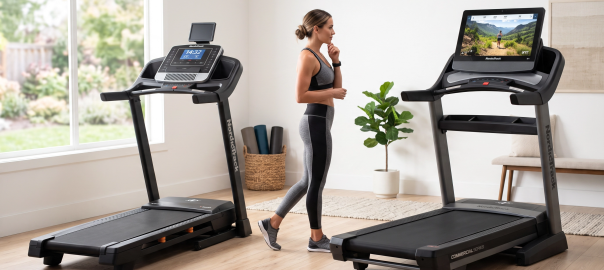
The T Series 5 uses an LED display for workout stats and includes a device shelf for the user’s own phone or tablet. The Commercial 1250 integrates a 10-inch tilting touchscreen directly into the machine. Higher-end Commercial models offer even larger displays, making iFIT workouts feel more immersive without requiring a separate device.
The T Series approach is practical and keeps cost down – buyers who already own a tablet may not miss the built-in screen. The Commercial setup is more seamless but introduces a more complex component that requires servicing if it fails. Neither approach is wrong; the choice depends on how much the guided-workout experience factors into staying consistent.
T Series for Space and Value; Commercial for Performance
The T Series 5 measures approximately 68.3″ x 30.5″ when open – a footprint that fits comfortably in a bedroom or modest home gym. The Commercial 1250 measures approximately 75.1″ L x 34.3″ W x 58.4″ H when open, requiring a dedicated space with clearance behind the deck. The Commercial Series also weighs significantly more, which affects delivery, setup, and any repositioning later.
NordicTrack’s SpaceSaver folding design appears on several Commercial models, allowing the deck to fold upright after use – helpful for reducing the occupied footprint, though these machines are still heavy and far from portable.
Choose the T Series if:
- The primary activities are walking, incline walking, or light-to-moderate jogging
- Space is limited and a smaller footprint is a priority
- Budget is a key factor and high-speed running is not a regular goal
Choose the Commercial Series if:
- Running happens three or more times per week
- Multiple users with different fitness levels will share the treadmill
- Decline training, a wider belt, and a higher weight capacity are genuine needs
- Long-term durability under heavier use justifies the higher upfront cost
Most buyers land in one of two clear camps once they are honest about how the treadmill will actually be used week to week – and those two camps map almost perfectly onto these two series.
For more side-by-side treadmill comparisons, including weight capacity analysis across major brands, visit Get Health Tips – a resource covering practical fitness equipment guidance for home buyers.
