
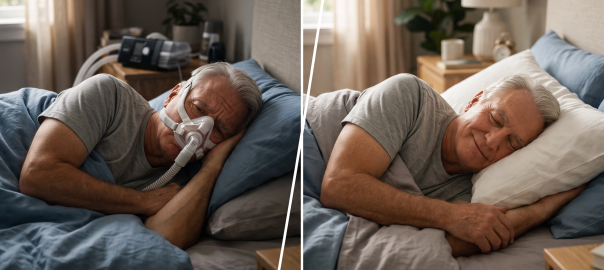
Up to 83% of CPAP users can’t stick with their treatment, but quitting isn’t the answer when untreated sleep apnea threatens your heart, brain, and daily safety. What if the solution isn’t fixing CPAP tolerance, but finding what actually works for your body?
Key Takeaways
Between 29% and 83% of CPAP users struggle with compliance – but stopping treatment entirely carries serious health risks.
Oral appliances (mandibular advancement devices) are an AASM-endorsed first-line alternative for mild to moderate OSA, and are also recommended for severe OSA when CPAP is not tolerated.
Several effective alternatives exist beyond oral appliances – including BiPAP, Inspire Upper Airway Stimulation, and EPAP devices – each matched to different severity levels and lifestyles.
Lifestyle changes like weight loss and positional therapy can meaningfully reduce OSA severity on their own or alongside other treatments.
The right alternative depends on how severe your sleep apnea is, your anatomy, and your personal preferences – a sleep study is the starting point for figuring that out.
Up to 83% of CPAP Users Struggle – And Quitting Isn’t the Answer
The numbers are striking. Research shows that anywhere from 29% to 83% of patients prescribed CPAP therapy don’t consistently use it. The reasons are well-documented: mask discomfort, claustrophobia, skin irritation, nasal dryness, air pressure that feels impossible to breathe against, and the sheer inconvenience of traveling with the equipment. For some people, putting on a CPAP mask triggers a full panic response – not a manageable inconvenience, but a nightly crisis.
What matters here is what happens next. Many people quietly stop using the machine without telling their doctor, assuming poor sleep is better than the stress of treatment. That assumption is dangerous. Resources like Get Health Tips’ sleep apnea program exist precisely because untreated OSA has real consequences – and because quitting CPAP doesn’t have to mean quitting treatment.
Why Untreated Sleep Apnea Is Never a Safe Default
Obstructive sleep apnea causes the airway to repeatedly collapse during sleep, cutting off oxygen – sometimes dozens or even hundreds of times per night. Over time, this oxygen disruption places serious stress on the cardiovascular system. Untreated OSA is linked to high blood pressure, heart disease, stroke, and type 2 diabetes, along with a significantly elevated risk of accidents caused by daytime sleepiness.
The condition also worsens mental health, contributing to depression and anxiety. Sleep apnea is a medical condition that needs to be managed – not a snoring problem that can be safely ignored. The goal is to find treatment that actually works for the individual.
How Oral Appliances Actually Work
Oral appliance therapy (OAT) is one of the most well-studied CPAP alternatives available. The American Academy of Sleep Medicine (AASM) recommends it as a first-line treatment for patients with mild to moderate OSA who prefer it over CPAP, and for those with severe OSA who are unable to tolerate CPAP. A study published in the Journal of Clinical Sleep Medicine confirmed that oral appliances significantly reduce the Apnea-Hypopnea Index (AHI) – the metric used to measure how many breathing disruptions occur per hour of sleep.
The Mandibular Advancement Mechanism
The most common type of oral appliance is the Mandibular Advancement Device (MAD). These devices hold the lower jaw (mandible) in a slightly forward position during sleep. That forward repositioning physically widens the space at the back of the throat, preventing the soft tissue collapse that causes apnea events. As the jaw moves forward, the tongue follows – which matters, since tongue position is one of the primary contributors to airway obstruction in OSA patients.
The degree of advancement is adjustable, and titration – gradual forward movement over several appointments – allows a sleep dentist to dial in the optimal position without causing jaw soreness. Most patients adapt within a few weeks.
Custom Fit vs. Over-the-Counter Devices
This distinction matters more than most patients realize. Custom-fitted MADs, fabricated from dental impressions by a qualified sleep dentist, conform precisely to the patient’s teeth and jaw anatomy. Over-the-counter boil-and-bite devices are available without a prescription, but they lack the precise fit needed to reliably hold the airway open at a therapeutic position and cannot be titrated.
For mild snoring, an OTC device might provide some relief. For diagnosed OSA, a custom device is the clinically appropriate option. Professionally fitted oral appliances are also often covered by insurance when prescribed for OSA treatment.
AASM-Endorsed Alternatives Worth Knowing
Oral appliances are not the only option with strong clinical backing. Several other therapies suit different patient profiles.
BiPAP: Dual-Pressure Relief
BiPAP (Bilevel Positive Airway Pressure) machines deliver two distinct pressure settings: a higher pressure during inhalation and a lower pressure during exhalation. For patients who struggle specifically with the sensation of breathing out against CPAP’s constant pressure – a common complaint – BiPAP can feel dramatically more natural. It is particularly useful for patients with more severe OSA or those who also have conditions like COPD that make exhalation against pressure difficult.
Inspire Upper AWeight Loss and Positional Therapyirway Stimulation
Inspire therapy is an FDA-approved implantable device designed for moderate to severe OSA patients who haven’t responded adequately to CPAP. A small device implanted under the skin monitors breathing patterns throughout the night. When it detects the beginning of an apnea event, it delivers a mild electrical pulse to the hypoglossal nerve – the nerve that controls tongue movement – gently pushing the tongue forward to reopen the airway. The patient controls it with a small handheld remote and feels no pain from the stimulation. Eligibility requires specific anatomical criteria and a documented history of CPAP failure.
EPAP Devices: Provent Is Gone, But Bongo Rx Carries the Torch
Expiratory Positive Airway Pressure (EPAP) devices are small valves worn over the nostrils during sleep. When the patient exhales, the valve creates backpressure that helps splint the airway open. Provent – the most recognized EPAP brand – has been discontinued, but Bongo Rx has emerged as its functional successor, using a similar nasal valve mechanism and requiring a prescription. EPAP devices are notably compact and travel-friendly compared to any PAP machine.
Lifestyle Changes That Move the Needle
Weight Loss and Positional Therapy
These are not soft recommendations – they produce measurable changes in AHI scores. Research published in the Journal of Clinical Sleep Medicine found that a 10% reduction in body weight can significantly reduce sleep apnea severity. Fat deposits around the neck and upper airway directly contribute to obstruction, so reducing them addresses the mechanical problem at its source.
Positional therapy addresses a different mechanism. For patients whose OSA occurs mostly when sleeping on the back (supine position), training the body to sleep on one side can produce a meaningful reduction in apnea events. Wearable positional devices, wedge pillows, and vibrating feedback devices are all available options. Positional therapy rarely works as a standalone treatment for moderate or severe OSA, but adds real value as part of a combined approach.
Reducing alcohol consumption and quitting smoking are also worth emphasizing. Alcohol relaxes the throat muscles, directly worsening airway collapse. Smoking causes inflammation in the airway lining, narrowing the passage further.
Matching the Right Treatment to Your Severity
OSA severity is classified using the AHI score – the number of apnea or hypopnea (partial obstruction) events per hour of sleep. Mild OSA is generally 5-14 events per hour, moderate is 15-29, and severe is 30 or more.
- Mild OSA: Oral appliances, positional therapy, and weight loss are appropriate first steps. EPAP devices like Bongo Rx may also be worth discussing.
- Moderate OSA: Oral appliances remain a strong option. BiPAP may be considered if PAP therapy is preferred but CPAP pressure isn’t tolerated.
- Severe OSA: CPAP or BiPAP remain the most effective non-surgical options. Inspire therapy is available for those who fail PAP therapy and meet eligibility criteria.
- Surgical options like uvulopalatopharyngoplasty (UPPP) or genioglossus advancement are considered when anatomy is a primary factor and other treatments have failed.
No treatment works the same across all patients. Anatomy, comorbidities, and personal tolerance all factor into what will actually be used consistently – and consistent use is what produces outcomes.
How Sleep Apnea Is Diagnosed: From Doctor Eval to Sleep Study
A formal diagnosis is the non-negotiable starting point. OSA cannot be reliably diagnosed from symptoms alone. Two types of sleep studies are typically used:
Polysomnography (PSG): An overnight, in-lab study that measures brain activity, oxygen levels, heart rate, breathing, and body movement simultaneously. Considered the gold standard.
Home Sleep Apnea Test (HSAT): A portable device worn at home that measures airflow, respiratory effort, and oxygen saturation. More accessible and less expensive than PSG, though it captures less data and is generally recommended for straightforward suspected OSA cases.
The severity confirmed by a sleep study directly determines which treatment options are appropriate and what insurance will cover. Self-treating without a diagnosis – even with an OTC oral device – means treating without knowing the actual problem.
Effective Sleep Apnea Treatment Exists – CPAP Is Just One Option
The idea that CPAP is the only real option is outdated. The AASM formally endorses oral appliances, BiPAP, and Inspire therapy as legitimate treatment pathways. Lifestyle interventions carry clinical weight. EPAP devices fill a niche for the right patient. Surgical options exist for specific anatomical situations.
CPAP intolerance should trigger a conversation with a sleep specialist about what else is available – not resignation. The goal of sleep apnea treatment is consistent airway management throughout the night, and there are multiple roads to that outcome.
For more evidence-based guidance on sleep health and OSA management, Get Health Tips covers practical, research-backed strategies to help people breathe easier and sleep better.
